
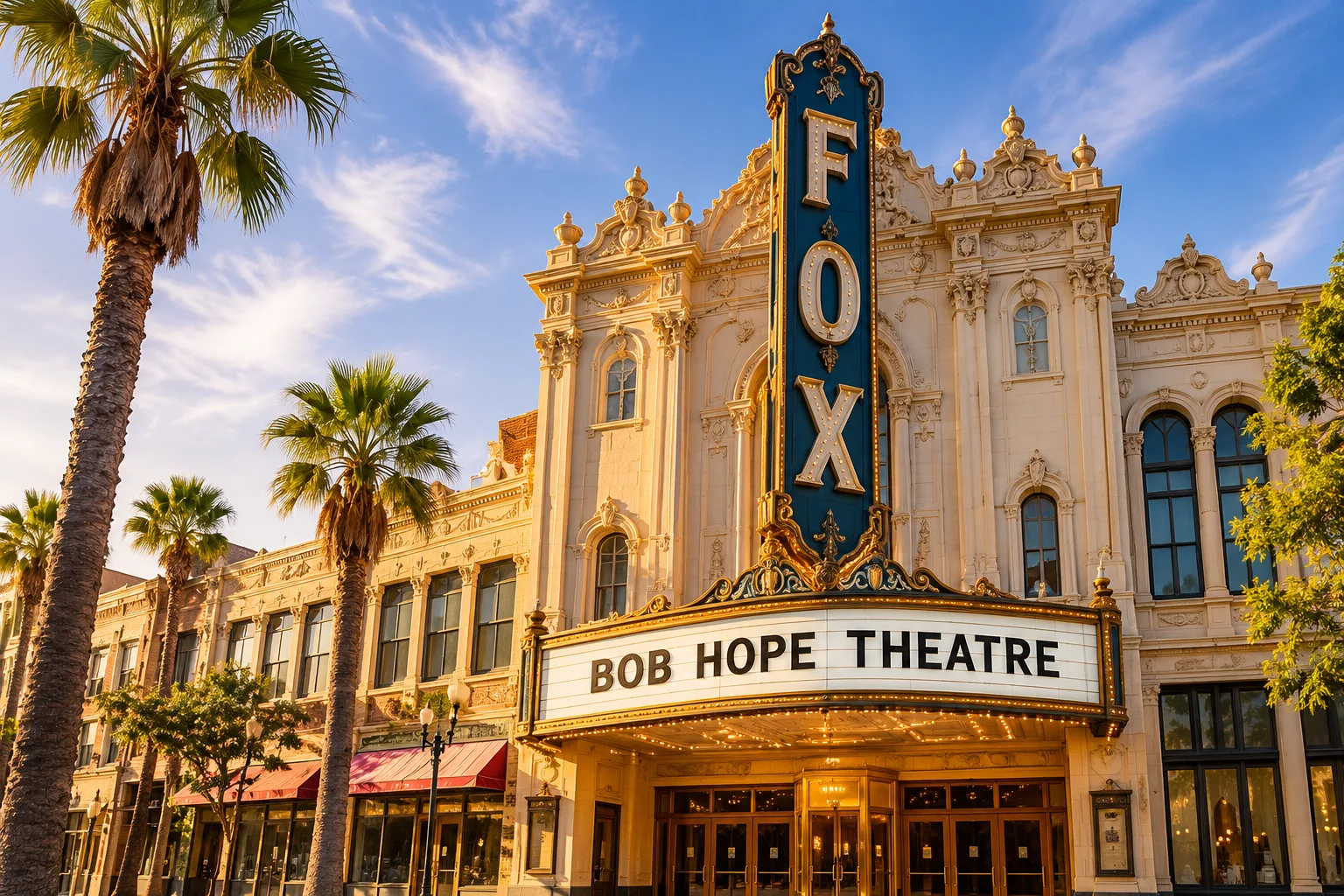
The Bob Hope Theatre’s history begins well before its present name appeared on the building. At 242 East Main Street, a former movie palace connects Stockton’s entertainment business, downtown architecture, and decades of preservation work. Its story is also a useful reminder that a familiar landmark can belong to several different eras at once.
The Fox California identity recalls an ambitious theatre built in 1930. The Bob Hope name belongs to a much later restoration. Between those dates are changing audiences, volunteers, conservation specialists, and decisions about what a city should keep. Looking at those layers makes the building more interesting than a simple before-and-after photograph.
A familiar address, a new building
The 1979 National Register nomination explains that Fox West Coast Theaters replaced the earlier T&D theatre on this site. The new building represented a substantial investment in a venue intended to attract audiences from Stockton and the surrounding region, including the Mother Lode.
That regional ambition helps explain its scale. A downtown theatre could give people another reason to come into the city, bringing an evening’s entertainment into the same street network as shops and offices. The building’s address mattered alongside its architecture: audiences had to reach it, recognize it, and find their way home afterward.
For a wider look at that setting, Main Street, Then & Now offers a way to compare a landmark with the changing streets around it. The theatre remained a reference point even as neighboring businesses and travel habits changed.
October 1930: a city turns out
The City of Stockton’s theatre history dates the grand opening to October 14, 1930, and reports a celebration attended by approximately 20,000 people. That figure describes the opening festivities, not the number of seats inside the auditorium.
The distinction matters. A theatre opening could become a street event as well as an indoor performance. People could participate by gathering outside, looking at the building, or following accounts afterward. The occasion therefore tells us something about civic attention, even though it cannot tell us what every person in the crowd thought about the new venue.
The opening film was Up the River, with Spencer Tracy, according to the Friends of the Fox history. That detail places the theatre within the growing business of sound cinema, even though its stage also allowed live entertainment.
Inside the movie palace

The nomination describes a two-story entrance rotunda, a mezzanine, and a large stage designed for both live performances and motion pictures. It identifies the architecture as late Spanish Colonial Revival. Painted plaster gave some ceiling beams and balcony details the appearance of carved wood, creating richness through skilled surface treatment.
These details suggest how the building organized an audience’s experience. The entrance offered a transition from the street; the auditorium directed attention toward the stage. Decoration was part of that movement. Looking upward and then toward the proscenium helps reveal how the room’s different surfaces work together, instead of treating each ornament as an isolated curiosity.
The restoration began with investigation
According to EverGreene’s account of its conservation work, earlier repainting had covered patterns and altered the historic palette. Conservators studied finishes and exposed small areas of earlier decoration before developing the restoration scheme. Cleaning, repair, decorative painting, and gilding all played roles.
Look for evidence behind the appearance
A richly decorated interior does not explain its own history. Ask which surfaces survived, which were repaired, and which were recreated using physical evidence. That distinction makes restoration easier to understand: the finished room reflects research and practical decisions, as well as the original designers’ intentions.
The long work of keeping the Fox
The building entered the National Register of Historic Places in 1979, as its federal listing record confirms. Recognition, however, did not by itself provide every repair, performance, or maintenance decision the theatre would need.
Friends of the Fox traces its organization to December 1995. Its history describes volunteers supporting restoration and a seat-sponsorship campaign during the major renovation that began in 2002. Those activities show preservation operating at several scales: formal recognition, construction work, fundraising, and people willing to keep meeting while the building was closed.
The result was a shared project rather than a single rescue moment. Small contributions and specialist work belonged to the same effort, although they took different forms.
A rescued organ with its own journey

The theatre’s Robert Morton organ adds another timeline. The instrument dates to 1928 and previously belonged to Seattle’s Fox Theatre. It should not be confused with the Wurlitzer described in Stockton’s original theatre documentation.
The Friends of the Fox account of the organ restoration follows its recovery from long storage and the work of volunteers and specialists. Pipes, woodwork, and other components needed attention before the instrument could return to use. The story gives a concrete sense of the labor hidden behind a polished console.
An instrument that moved between cities can still become part of a local institution. Its earlier life, restoration, and later use all belong in the record. Keeping those stages separate allows the organ’s contribution to Stockton to be appreciated without inventing an unbroken history in one building.
Why the Bob Hope name arrived in 2004
The city records restoration completion on September 18, 2004. It also identifies federal and state support and a contribution from Stockton developer Alex G. Spanos. At Spanos’s request, the City Council named the theatre for entertainer Bob Hope. The present name therefore marks a later chapter in the building’s life, not its original opening.
The project also had to support contemporary performances. WMB Architects’ renovation account describes work on theatrical lighting, audio, rigging, and other building systems. Preserving the historic atmosphere went alongside making the venue usable. Much of that work is less immediately noticeable than the decorative ceiling.
An active part of Main Street
The official venue page provides current performance information and describes features including the lobby mosaic and refurbished seating. Those present-day uses continue the building’s role as a place where people gather.
That continuing purpose is part of the preservation story. An auditorium needs audiences as well as repaired plaster. Each generation encounters the building through its own performances and memories, while the surviving fabric supplies a connection to experiences that came before.
Read alongside Stockton’s broader history, the theatre becomes a meeting point between entertainment, investment, and care for the built environment. Its changing names identify different chapters; its continued use keeps adding to them.